
BenchKit
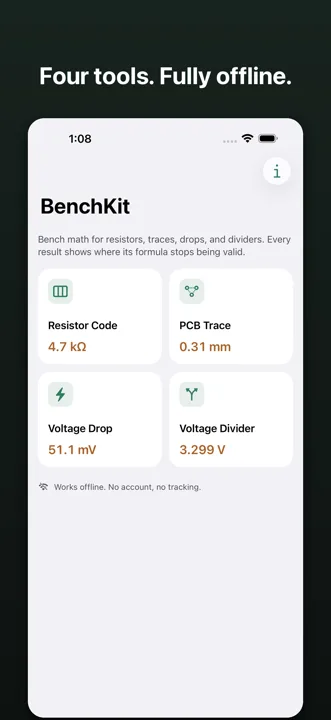
The four calculations you actually redo at the bench — resistor codes, PCB trace width, voltage drop and dividers — with the answer on top and its limits written right beside the number. Offline, with the formula and the source for every tool.


What it does
Tap the band, pick the colour
Decode 3-, 4-, 5- and 6-band resistors by tapping a drawn resistor, or read SMD codes: 3-digit, 4-digit, EIA-96 and R notation. You get the tolerance range and the E-series match, and a warning when a reading is probably backwards.
Limits beside the number
PCB results outside the IPC-2221 chart are flagged as extrapolations. Voltage drop states its constant-current assumption. The divider is ideal and unloaded unless you add a load — then it shows what the load does.
Works the way you write
Type 4k7, 2R2, 100m or 3V3. Solve the other way round too: the current a trace can carry, the closest E24/E96 pair for a target voltage, the drop from wire gauge and length. Each tool remembers your last inputs on the device.
Bench-side, so offline
No sign-in, no network, no ads. Every tool lists its formula and sources — IEC 60062, IEC 60063, IPC-2221, IEC 60028 and ASTM B258.
Questions
Which standard does the trace width use?
Does it replace a proper simulator?
Is it free?
Details
This app collects nothing. No account, no analytics, no advertising identifier.