Tianjin mahjong — the variant with a wild tile and no ron
Tianjin plays mahjong its own way, and almost none of it is written down in English. What the hun does, why nobody can win off a discard, and how one ordinary wait ended up with a name of its own.
A city that plays its own game
Mahjong in China is not one game. Every province, and often every city, keeps a version with its own hands, its own arithmetic and its own vocabulary. Tianjin's is unusually compact: no chow, no winning off another player's discard, no seven pairs, and one tile per round promoted to a wild. Six scoring hands, and that is the whole ruleset.
You can teach it in five minutes. People then argue about it for years.
The hun: one tile that stands for anything
Each round designates one tile as the hun — the wild. It can stand in for whatever your hand is missing. Locals pronounce it with Tianjin's rolled ending, closer to hunr than hun, and the sound of that word is most of what the game sounds like from the next table.
Two of the six hands are defined by what you do with it. Hundiao (2 fan) means you finish holding a wild and win on the pair. Sutiliu (2 fan) means you won without touching one at all — the plainest hand there is.
Notice that those two are worth exactly the same. The purest hand in the game scores no better than the one propped up by a wild. Tianjin is not impressed by purity.
Nobody ever deals in
There is no ron. You cannot win on a tile someone else discards. Every win is self-drawn, and the winner collects from all three opponents at once.
It is worth sitting with what that removes. In Japanese riichi, something like half the skill is defence: reading what an opponent is waiting on, folding a good hand, feeding only safe tiles. In Tianjin there is nothing to deal into. A discard cannot lose you the hand. You lose by being slower than someone else, and by nothing else.
It also means no single player eats the loss. All three pay the same. There is no villain at the table who fed the winner, and no post-mortem about one careless tile. Anyone who has watched a mahjong table argue for ten minutes about a single discard will recognise that as a deliberate kind of peace.
Zhuowu: a wait so ordinary it got a name
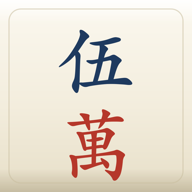
Hold the four and the six of characters, wait on the five. Everywhere else in the mahjong world this is just a closed wait, the weakest shape you can be left with. In Tianjin it is a named, scored hand — zhuowu, “catching the five”, worth 3 fan, and only in the character suit.
Nothing about the shape earns that. It is scored because enough people cared about it often enough that it needed a name.
The arithmetic has a seam in it
Hands multiply. Hundiao (2) together with benhunlong (8) is 16, not 10. That is the rule, and it is why big hands in Tianjin get very big very fast.
Except for two of them. Zhuowu (3) and long (4) add: 3 + 4 = 7. No principle explains the exception. It is residue — the trace of how people actually settled up around a table, preserved because everybody already knew it.
Rulesets that grew at a table always have a seam like this somewhere. It is the quickest way to tell a living local variant from one reconstructed out of a rulebook.
The names are half of it
Sutiliu. Benhunlong — your long, the 123-456-789 run, happening to land in the same suit as this round's wild, worth 8 fan. These are not translations of standard mahjong terms. They are Tianjin words, and they are meant to be said out loud.
Tianjin is a treaty port and the home of xiangsheng, Chinese crosstalk: a city that has always prized a quick mouth. A game with few rules, fast hands and names you enjoy pronouncing is a fairly Tianjin thing to end up with.
And the scoring, briefly
Hand fans multiply, kongs score separately (1 fan exposed, 2 concealed), and being dealer or chaining the deal doubles the total, up to eight times. Total = (hand + kong) x dealer multiplier, and the winner collects that from each of the other three.
House rules vary from table to table, in Tianjin as everywhere else. This describes one widely played set — the same one implemented in the app below.
Full fan table and worked scoring →
Scores the Tianjin dialect of mahjong correctly — a ruleset almost nothing else supports.